Pages

Tuesday, November 22, 2011

DOJI

The Doji is a powerful Candlestick formation, signifying indecision between bulls and bears. ADoji is quite often found at the bottom and top of trends and thus is considered as a sign of possible reversal of price direction, but the Doji can be viewed as a continuation pattern as well.

A Doji is formed when the opening price and the closing price are equal

TRADING IDEA

IN A DOWNTREND BUY IF CLOSE ABOVE DOJI HIGH PLACE

DOJI LOW AS A STOPLOSS TGT:BUYPRICE-STOPLOSS+BUYPRICE

EX:DOJI HIGH 105 LOW 95 CLOSING 106.50 BUYING PRICE=106.50 STOPLOSS=95 TGT=106.50-95+106.50=118 1ST TGT

2ND TGT=106.50-95+118=129.50........

Wednesday, November 16, 2011

Useful rules for trading in the share market.

Before starting the trade in stock market you should be aware of some rules to gain good returns. Some of those are listed here.
1. Divide your capital into few equal parts, never do risk trading more than one part of it.

2. Trade only in active and high volume stocks.

3.Always use stop-losses

4. Never over trade and stick to your risk management rules.

5.Never let profit turn into a loss. Use trailing stops to protect and lock your profits.

6. Never get into market because you are anxious from waiting and never get out of the market just because you have lost your patience.

7. Do not guess where the top and bottom of the market is but let the market signal its top and bottom

8.Never average a loosing trade , also avoid taking small profits and big losses.

9. Only trade with genuine capital and be aware of the risk of losing

10. Always trade with in capabilities.

11.Never let greed (or) fear take control over your winning positions.

12.Avoid Tips and Rumors. These are spread by people with vested interests.

Monday, November 7, 2011

YES YOU CAN...!

EMA
Entry rules: When 10 EMA goes through 25 EMA and continues through 50 EMA, BUY/SELL in the direction of 10 EMA once it clearly makes it through 50 EMA. (Just wait for the current price bar to close on the opposite site of 50 EMA. This waiting helps to avoid false signals).
Exit rules: option1: exit when 10 EMA crosses 25 EMA again.
option2: exit when 10 EMA returns and touches 50 EMA (again it is suggested to wait until the current price bar after so called “touch” has been closed on the opposite side of 50 EMA).
SMA
Use time frame and currency which respond the best (1 hour, 1 day… or any other).
Indicators: (multiple of 7) 7 SMA, 14 SMA, 21 SMA.
Entry rules: When 7 SMA goes through 14 and continues through 21, BUY/SELL in the direction of 7 SMA once price gets through 21 SMA.
Exit rules: exit when 7 SMA goes back and touches 21 SMA.
28/100 MA
Indicators: 100Ema applied to close and 28 smooth moving average applied to close.
Time frame: 1hr and 4hr
Currency: Any, but i guess Eur/usd would be preferable.
Entry: the 100ema shows the trend. So if we were in a down trend as given by the 100ema and a candle closes above the 100ema, we enter a buy, you would stay in that buy until a candle closes below the 28 and re-entries are made using the 28 once price touches it or closes above it when it has first closed below it. The reverse is for a sell trade.
For 1hr, stop loss should be 50-60pips while take profit should be 70-120pips, for 4hr stop loss should be 100pips while take profit should be 100-500pips.
Stochastic High-Low
Time frame: Any.
Indicator: Full Stochastic (14, 3, 3)
Entry rules: When Stochastic has crossed below 20, reached 10, and then crossed back up through 20 – set BUY order.
Entry rules: Sell when Stochastic has crossed above 80, reached 90, and then crossed back down through 80.
Exit rules: close trade when Stochastic lines rich the opposite side (80 for Buy order, 20 for Sell order). Advantages: gives quite accurate entry/exit signals in well trending market. Disadvantages: needs periodical monitoring. Stochastic is suggested to be used along with other indicators to eliminated entering on false signals.
RSI High-Low
Time frame: Any.
Indicator: RSI (14) with levels at 70 and 30.
Entry rules: Buy when RSI has crossed below 30, formed a bottom, and then crossed back up through 30.
Entry rules: Sell when RSI has crossed above 70, formed a peak, and then crossed back down through 70. Exit rules: not set.
Advantages: RSI is a very good indicator to refer for confirmation for any entry in any simple or complex trading system. For current trading method it advices well on entries, but opportunities occur not that often. Disadvantages: monitoring is needed, still false signals take place. Strategy is suggested to be used in combination with other ones.
Stochastic lines crossover

Time frame: Any.
Indicator: Stochastic (14, 3, 3)
Entry rules: Buy when the faster moving Stochastic line crosses above and up over slower moving stochastic line. Exit rules: Sell when the opposite situation (next crossover) occurs and right after that open an opposite position. It is again recommended, once the first touch of Stochastic lines (possible future crossover) has been spotted, to wait until the following price bar on the chart has closed and only then take actions. Advantages: can give entry and exit rules, easy to use. Disadvantages: Stochastic is a lagging indicator – with this lines crossover system it can create a lot of false signals. Traders may want to change Stochastic regular settings for each particular currency pair to eliminate asmany false signals as possible. Stochastic crossover system is good when used in combination with other indicators.
Simple MACD crossover
We will need only MACD indicator with standard settings: 12, 26, 9.
Any time frame as well as any currency pair can be used. Entry rules: When the MACD lines’ crossover appears – enter (or wait for the price bar to close and then enter).
Exit rules: when MACD lines next crossover occurs.

ADX Power
- Timeframe: I use it on 4 hours, feel free to use it on smaller timeframes as well
- Currency Pair: Any
- Indicators: EMA9 and EMA26 and DMI (Directional Movement Indicator with ADX)
- DMI Settings: Draw a horizental line at 25 to watch for the crossovers of DI+ or DI-
- ADX Settings: Ignore signals where ADX is lower 20GO LONG WHEN:
- EMA9 has crossed over EMA26
- DI+ >= 25
- ADX >= 20
- ADX is in between DI+ and DI-
EXIT LONG WHEN:
- EMA26 has crossed EMA9 AND
- DI- is higher than DI+
GO SHORT WHEN:
- EMA26 has crossed EMA9
- DI- >= 25
- ADX >= 20
- ADX is in between DI- and DI+
EXIT SHORT WHEN:
- EMA9 has crossed EMA26 AND
- DI+ is higher than DI-
WHAT TO IGNORE:
WHAT TO IGNORE:
- While in Long Position: DI+ and DI- Cross-overs while the EMA9 is still on top of EMA26
- While in Short Position: DI+ and DI- Cross-overs while the EMA26 is still on top of EMA9
- While searching for Trading Opportunities: The EMAs has crossed over but the DI+ or DI- (depending on whether you're looking for Long or Short positions) are still under 25. Also, wait till the ADX has reached 20 before entering into Trade
- Price breaking the Lower EMA (EMA26 in case of Long Positions) line while the EMA9 is still on top of EMA26


Saturday, October 29, 2011

ADX Indicator

The ADX index measures the strength of a trend and can be usefull to ditermine if a trend is strong or weak.When this indicator is showing a low reading then a trading range is likely to develop. Avoid stocks with low readings! You want to be in stocks that have high readings.

This indicator stands for Average Directional Index. On some charting packages there are two other lines on the chart, +DI and -DI (the DI part stands for Directional Indicator). Ignore these lines. Trying to trade according to these two lines is a great way to lose money!

The only thing that we are concerned with is the ADX itself.

Note: This indicator measures strong or weak trends. This can be either a strong uptrend or a strong downtrend. It does not tell you if the trend is up or down, it just tells you how strong the current trend is!

Let's look at a chart:

chart of adx indicator

In the chart above, the ADX indicator is the thick black line (arrow). The other lines are the +DI and –DI (ignore these). The highlighted areas show how this indicator identifies trading ranges. ADX is showing a low reading and the stock is chopping around sideways.

Now look at what happens when the indicator gets into higher territory. A strong trend develops! These are the type of stocks that you want to trade.

On the right side of the indicator panel you will see a scale from 0 to 100 (only 0 through 80 are marked). Here are my guidelines for using the scale:

ADX Indicator Scale

If ADX is between 0 and 25 then the stock is in a trading range. It is likely just chopping around sideways. Avoid these weak, pathetic stocks!

Once ADX gets above 25 then you will begin to see the beginning of a trend. Big moves (up or down) tend to happen when ADX is right around this number.

When the ADX indicator gets above 30 then you are staring at a stock that is in a strong trend! These are the stocks that you want to be trading!

You won't see very many stocks with the ADX above 50. Once it gets that high, you start to see trends coming to an end and trading ranges developing again.

Tips

The only thing I use the ADX for is an additional filter in my scans, so that I can find stocks that are in strong trends. I do not even have the ADX indicator on the charts that I look at when I am looking for setups. Since the ADX is already factored into the scans, I don't need it added to the chart itself.

I don't pay any attention to the rising and falling of the ADX indicator. Stocks can go up for long periods of time even though the ADX may be falling (indicating that the trend is getting weak). The ideal scenario is that the ADX is rising, but I don't find it necessary to take a trade.

I don't use any technical indicators on my charts. I found out that technical indicators just clouded my judgement. One technical indicator may indicate a buy and one may indicate a sell. Needless to say, this can be very confusing and it just takes you attention away from the only thing that matters - PRICE.

So what is the ADX indicator good for?

This indicator is best used for screening stocks and writing scans. By adding this indicator to your scanning software, you can eliminate all of the stocks that are in trading ranges. You can then set up your scan to find only those stocks that are in strong up trends or strong down trends.

The ADX indicator does not give buy or sell signals. It does, however, give you some perspective on where the stock is in the trend. Low readings and you have a trading range or the beginning of a trend. Extremely high readings tell you that the trend will likely come to an end.

Candlestick Patterns

hey must be combined with other forms of technical analysis to really be useful. For example, when you see one of these patterns on the daily chart, move down to the hourly chart. Does the hourly chart agree with your expectations on the daily chart? If so, then the odds of a reversal increase.

The following patterns are divided into two parts: Bullish patterns and bearish patterns. These are reversal patterns that show up after a pullback (bullish patterns) or a rally (bearish patterns).

Bullish Candlestick Patterns

bullish candlestick patterns

Engulfing:This is my all time favorite candlestick pattern. This pattern consists of two candles. The first day is a narrow range candle that closes down for the day. The sellers are still in control of the stock but because it is a narrow range candle and volatility is low, the sellers are not very aggressive. The second day is a wide range candle that "engulfs" the body of the first candle and closes near the top of the range. The buyers have overwhelmed the sellers (demand is greater than supply). Buyers are ready to take control of this stock!

Hammer: As discussed on the previous page, the stock opened, then at some point the sellers took control of the stock and pushed it lower. By the end of the day, the buyers won and had enough strength to close the stock at the top of the range. Hammers can develop after a cluster of stop loss orders are hit. That's when professional traders come in to grab shares at a lower price.

Harami: When you see this pattern the first thing that comes to mind is that the momentum preceding it has stopped. On the first day you see a wide range candle that closes near the bottom of the range. The sellers are still in control of this stock. Then on the second day, there is only a narrow range candle that closes up for the day. Note: Do not confuse this pattern with the engulfing pattern. The candles are opposite!

Piercing: This is also a two-candle reversal pattern where on the first day you see a wide range candle that closes near the bottom of the range. The sellers are in control. On the second day you see a wide range candle that has to close at least halfway into the prior candle. Those that shorted the stock on first day are now sitting at a loss on the rally that happens on the second day. This can set up a powerful reversal.

Doji: The doji is probably the most popular candlestick pattern. The stock opens up and goes nowhere throughout the day and closes right at or near the opening price. Quite simply, it represents indecision and causes traders to question the current trend. This can often trigger reversals in the opposite direction.

Bearish Candlestick Patterns

bearish candlestick patterns

You'll notice that all of these bearish patterns are the opposite of the bullish patterns. These patterns come after a rally and signify a possible reversal just like the bullish patterns.

Ok, now it's your turn! I'll let you figure out what is happening in each of the patterns above to cause these to be considered bearish. Look at each candle and try to get into the minds of the traders involved in the candle.

Kickers

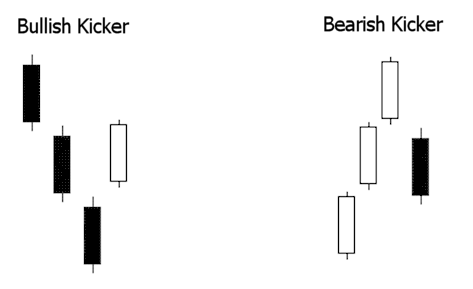
There is one more pattern worthy of mention. A "kicker" is sometimes referred to as the most powerful candlestick pattern of all.

kicker candlestick patterns

You can see in the above graphic why this pattern is so explosive. Like most candle patterns there is a bullish and bearish version. In the bullish version, the stock is moving down and the last red candle closes at the bottom of the range.

Then, on the next day, the stock gaps open above the previous days high and close. This "shock event" forces short sellers to cover and brings in new traders on the long side.

This is reversed in the bearish version.

Wait For Confirmation?

Most traders are taught to "wait for confirmation" with candlestick patterns. This means that they are supposed to wait until the following day to see if the stock reverses afterward. This is absolutely ridiculous!

Tuesday, September 20, 2011

MOVING AVERAGE


How to trade with Moving Averages ?
Moving Averages are particulary useful in identifying the direction of an uptrend or downtrend of stocks and markets in general. They are based on the previous data and hence are generally referred to as lagging indicators which help us in locating the trend and following on in the trend . Since they do not allow you to predict the trend, you have to use other technical indicators in conjunction with them during trading.
Generally, the most common way to trade with the Moving averages is this – If the price crosses above the moving average, it means that a buying interest has set in – and thus indicates a buy signal. Similarly when the price crosses down the moving average, it means that a selling pressure has set in – thus indicates a sell signal.
Although it helps in indicating the current trend, it does not indicate for how long this trend would continue or when does the reverse trend begin. So traders should be cautious about this when using the moving averages for planning trades. It is also important to consider the volume for the security in question before trading. Sporadic movements with low volumes can generate erratic signals.
Example :
Look at this chart of Reliance capital shown below. The bold yellow line indicates the price and the thin blue line indicates the 9-day Simple Moving Average of the Close price of this stock.
moving-average-example
As you can see from the above chart, when the price has crossed above the SMA, then it indicates that buying interest has set in. From then on, the stock price is on a rise with minor dips. The downtrend is indicated at the point after the price crosses down the MA line. This indicates a down trend and becomes a candidate for sell signal. As can be seen the prices come down in the downtrend.
Longer and shorter Moving Averages
Moving averages can be configured any period of your choice. The most common ones are 9 Day, 30 Days, 50 days and the 200 Day Moving averages. The longer the period, smoothing will be more. Thus in stocks which display a great deal of sharp glitches and breaks, longer moving averages would make sense, as smoothing would be better. Choosing short period moving averages in such cases would result in erratic signals.
Short trends are identified by short period MAs – like the 9 day and 15 day MAs. A medium term trend is given by the 30 – 50 day moving averages. 100 and 200 day moving averages can indicate the intermediate long term trends.
Trading with Moving average Crossovers
Plotting both long term and short term Moving averages for the same security can lead to crossovers. This can also indicate some trading signals in some cases. A buy signal is generally assumed if the short term moving average crosses over the long term moving average. Similarly a sell signal can be indicated when the short moving average falls down the long term moving average.
Example: Look at this chart of the stock ABB in the NSE. The bold yellow line signifies the price movement of the stock. The blue line is the 30 day EMA and the brown line is the 200 day EMA.
moving-average-crossover-example
As can be seen from the chart, when the short term MA i.e the 30 day EMA (blue line) crosses over the long term MA ( 200 day EMA – brown line), then an uptrend is identified and thus a buy signal is generated.
As indicated earlier, MA can help in identifying trends and can give late trading signals. When used with other technical indicators, they can be very helpful in determining trading strategies.

Monday, September 12, 2011

How to Day Trade


Here’s one of the best day trading tips you’ll ever hear: When you make a serious decision to learn day trading, commit yourself to getting an excellent trading education.
Day trading is a profession, and as such, if you’re honestly going to learn to day trade stocks, Forex, futures, commodities or options, you’re going to need the best trading education you can find.
If you’re completely new to trading, I recommend a good, inexpensive book like Day Trading for Dummies. It won’t make you a successful day trader overnight (nothing will do that), but it will give you the basic concepts and vocabulary you need when you pursue a more in-depth education.
If you want to be one of the few who can successful do day trading for a living, then you’ll also need the proper tools: at least one fast computer with multiple monitors, a fast Internet connection, and an excellent broker.
You’ll also need day trading software (a Forex platform, stock trading software, or futures trading charts), to help provide you with trading signals through the use of technical analysis (chart reading).
As you journey through your trading education, you’ll have to decide what type of trading you want to do: Trend trading, swing trading, momentum trading, etc. This takes time as you won’t really know what style fits your personality until you try each of them.
In addition you’ll have to decide which market(s) you’ll want to trade. Do you want to do emini trading, Forex trading or online stock trading.
After getting the basics, you need to learn how to day trade by taking advantage of the study, research, and experience of successful traders who have come before you. You’ll also need to go beyond that to learn a specific trading methodology that has clear, objective rules and money management techniques.
Finally, before you begin trading with real money, you should test your methodology and get used to it by paper trading. Actually that’s an old term. Now there are many software programs available in which you can trade electronically using fake money. They are called “simulators” or your broker may provide a “demo account” that will do this for you.
As you can see, despite a lot of the marketing, learning how to day trade is not something you will do overnight. It is a career that requires a serious education and the commitment of a good amount of time and effort.
Trading is always risky, and there are never any guarantees, but for those who commit to it, learning how to day trade can provide a great income and lifestyle not found in many other professions.

    Wednesday, September 7, 2011

    Fibonacci

    Fibonacci

    The life and numbers of Fibonacci

    thanks to... R.Knott, D.A.Quinney and PASS Maths

    If XN appears as XN then your browser does not support subscripts or superscripts. Please use this alternative version.

    Have you ever wondered where we got our decimal numbering system from? The Roman Empire left Europe with the Roman numeral system which we still see, amongst other places, in the copyright notices after TV programmes (1997 is MCMXCVII).

    The Roman numerals were not displaced until the 13th Century AD when Fibonacci published his Liber abaci which means “The Book of Calculations”.

    Fibonacci, or more correctly Leonardo da Pisa, was born in Pisa in 1175AD. He was the son of a Pisan merchant who also served as a customs officer in North Africa. He travelled widely in Barbary (Algeria) and was later sent on business trips to Egypt, Syria, Greece, Sicily and Provence.

    In 1200 he returned to Pisa and used the knowledge he had gained on his travels to write Liber abaci in which he introduced the Latin-speaking world to the decimal number system. The first chapter of Part 1 begins:

    These are the nine figures of the Indians: 9 8 7 6 5 4 3 2 1. With these nine figures, and with this sign 0 which in Arabic is called zephirum, any number can be written, as will be demonstrated.

    Root finding

    Fibonacci was capable of quite remarkable calculating feats. He was able to find the positive solution of the following cubic equation:
    x^3+2*x^2+10*x = 20

    What is even more remarkable is that he carried out all his working using the Babylonian system of mathematics which uses base 60. He gave the result as 1;22,7,42,33,4,40 which is equivalent to:
    1 + 22/60 + 7/60^2 + 42/60^3 + 33/60^4 + 4/60^5 + 40/60^6

    It is not known how he obtained this, but it was 300 years before anybody else could find such accurate results. It is quite interesting that Fibonacci gave the result in this way at the same time as telling everybody else to use the decimal number system!

    Fibonacci sequence

    Fibonacci is perhaps best known for a simple series of numbers, introduced in Liber abaci and later named the Fibonacci numbers in his honour.

    The series begins with 0 and 1. After that, use the simple rule:

    Add the last two numbers to get the next.

    1, 2, 3, 5, 8, 13, 21, 34, 55, 89, 144, 233, 377, 610, 987,…

    You might ask where this came from? In Fibonacci’s day, mathematical competitions and challenges were common. For example, in 1225 Fibonacci took part in a tournament at Pisa ordered by the emperor himself, Frederick II.

    It was in just this type of competition that the following problem arose:

    Beginning with a single pair of rabbits, if every month each productive pair bears a new pair, which becomes productive when they are 1 month old, how many rabbits will there be after n months?

    Answer to rabbit problem

    Imagine that there are xn pairs of rabbits after n months. The number of pairs in month n+1 will be xn (in this problem, rabbits never die) plus the number of new pairs born. But new pairs are only born to pairs at least 1 month old, so there will be xn-1 new pairs.

    xn+1 = xn + xn-1

    Which is simply the rule for generating the Fibonacci numbers.

    The Golden Section

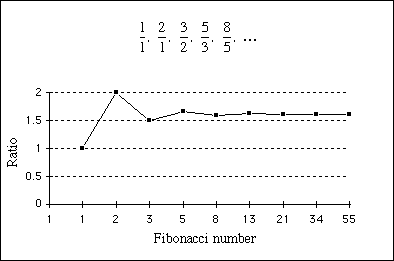
    A special value, closely related to the Fibonacci series, is called the golden section. This value is obtained by taking the ratio of successive terms in the Fibonacci series:

    Graph

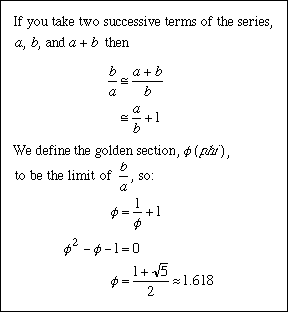
    If you plot a graph of these values you’ll see that they seem to be tending to a limit. This limit is actually the positive root of a quadratic equation (see box) and is called the golden section, golden ratio or sometimes the golden mean.

    box

    The golden section is normally denoted by the Greek letter phi. In fact, the Greek mathematicians of Plato’s time (400BC) recognized it as a significant value and Greek architects used the ratio 1:phi as an integral part of their designs, the most famous of which is the Parthenon in Athens.
    The Parthenon in Athens.

    Phi and geometry

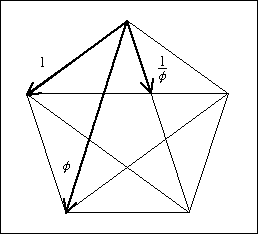
    Phi also occurs surprisingly often in geometry. For example, it is the ratio of the side of a regular pentagon to its diagonal. If we draw in all the diagonals then they each cut each other with the golden ratio too (see picture). The resulting pentagram describes a star which forms part of many of the flags of the world.

    Pentagram


    Fibonacci in nature

    The rabbit breeding problem that caused Fibonacci to write about the sequence in Liber abaci may be unrealistic but the Fibonacci numbers really do appear in nature. For example, some plants branch in such a way that they always have a Fibonacci number of growing points. Flowers often have a Fibonacci number of petals, daisies can have 34, 55 or even as many as 89 petals!

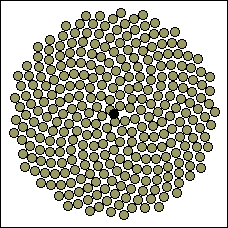
    Finally, next time you look at a sunflower, take the trouble to look at the arrangement of the seeds. They appear to be spiralling outwards both to the left and the right. There are a Fibonacci number of spirals! It seems that this arrangement keeps the seeds uniformly packed no matter how large the seed head.

    seeds

    sunflower

    Fibonacci in Maths

    The Fibonacci numbers are studied as part of number theory and have applications in the counting of mathematical objects such as sets, permutations and sequences and to computer science.

    CANDLE STICKS

    Candle Stick

    Introduction to Candlesticks

    History

    The Japanese began using technical analysis to trade rice in the 17th century. While this early version of technical analysis was different from the US version initiated by Charles Dow around 1900, many of the guiding principles were very similar:

    * The “what” (price action) is more important than the “why” (news, earnings, and so on).
    * All known information is reflected in the price.
    * Buyers and sellers move markets based on expectations and emotions (fear and greed).
    * Markets fluctuate.
    * The actual price may not reflect the underlying value.

    According to Steve Nison, candlestick charting first appeared sometime after 1850. Much of the credit for candlestick development and charting goes to a legendary rice trader named Homma from the town of Sakata. It is likely that his original ideas were modified and refined over many years of trading eventually resulting in the system of candlestick charting that we use today.

    Formation

    In order to create a candlestick chart, you must have a data set that contains open, high, low and close values for each time period you want to display. The hollow or filled portion of the candlestick is called “the body” (also referred to as “the real body”). The long thin lines above and below the body represent the high/low range and are called “shadows” (also referred to as “wicks” and “tails”). The high is marked by the top of the upper shadow and the low by the bottom of the lower shadow. If the stock closes higher than its opening price, a hollow candlestick is drawn with the bottom of the body representing the opening price and the top of the body representing the closing price. If the stock closes lower than its opening price, a filled candlestick is drawn with the top of the body representing the opening price and the bottom of the body representing the closing price.

    Candle2

    Compared to traditional bar charts, many traders consider candlestick charts more visually appealing and easier to interpret. Each candlestick provides an easy-to-decipher picture of price action. Immediately a trader can see compare the relationship between the open and close as well as the high and low. The relationship between the open and close is considered vital information and forms the essence of candlesticks. Hollow candlesticks, where the close is greater than the open, indicate buying pressure. Filled candlesticks, where the close is less than the open, indicate selling pressure.

    null

    Long Versus Short Bodies

    Generally speaking, the longer the body is, the more intense the buying or selling pressure. Conversely, short candlesticks indicate little price movement and represent consolidation.

    candle3

    Long white candlesticks show strong buying pressure. The longer the white candlestick is, the further the close is above the open. This indicates that prices advanced significantly from open to close and buyers were aggressive. While long white candlesticks are generally bullish, much depends on their position within the broader technical picture. After extended declines, long white candlesticks can mark a potential turning point or support level. If buying gets too aggressive after a long advance, it can lead to excessive bullishness.

    Long black candlesticks show strong selling pressure. The longer the black candlestick is, the further the close is below the open. This indicates that prices declined significantly from the open and sellers were aggressive. After a long advance, a long black candlestick can foreshadow a turning point or mark a future resistance level. After a long decline a long black candlestick can indicate panic or capitulation.

    candle4

    Even more potent long candlesticks are the Marubozu brothers, Black and White. Marubozu do not have upper or lower shadows and the high and low are represented by the open or close. A White Marubozu forms when the open equals the low and the close equals the high. This indicates that buyers controlled the price action from the first trade to the last trade. Black Marubozu form when the open equals the high and the close equals the low. This indicates that sellers controlled the price action from the first trade to the last trade.

    Long Versus Short Shadows

    The upper and lower shadows on candlesticks can provide valuable information about the trading session. Upper shadows represent the session high and lower shadows the session low. Candlesticks with short shadows indicate that most of the trading action was confined near the open and close. Candlestick with long shadows show that traded extended well past the open and close.

    candle5

    Candlesticks with a long upper shadow and short lower shadow indicate that buyers dominated during the session, and bid prices higher. However, sellers later forced prices down from their highs, and the weak close created a long upper shadow. Conversely, candlesticks with long lower shadows and short upper shadows indicate that sellers dominated during the session and drove prices lower. However, buyers later resurfaced to bid prices higher by the end of the session and the strong close created a long lower shadow.

    candle6

    Candlesticks with a long upper shadow, long lower shadow and small real body are called spinning tops. One long shadow represents a reversal of sorts; spinning tops represent indecision. The small real body (whether hollow or filled) shows little movement from open to close, and the shadows indicate that both bulls and bears were active during the session. Even though the session opened and closed with little change, prices moved significantly higher and lower in the meantime. Neither buyers nor sellers could gain the upper hand and the result was a standoff. After a long advance or long white candlestick, a spinning top indicates weakness among the bulls and a potential change or interruption in trend. After a long decline or long black candlestick, a spinning top indicates weakness among the bears and a potential change or interruption in trend.

    Doji

    Doji are important candlesticks that provide information on their own and as components of in a number of important patterns. Doji form when a security’s open and close are virtually equal. The length of the upper and lower shadows can vary and the resulting candlestick looks like a cross, inverted cross or plus sign. Alone, doji are neutral patterns. Any bullish or bearish bias is based on preceding price action and future confirmation. The word “Doji” refers to both the singular and plural form.

    candle7

    Ideally, but not necessarily, the open and close should be equal. While a doji with an equal open and close would be considered more robust, it is more important to capture the essence of the candlestick. Doji convey a sense of indecision or tug-of-war between buyers and sellers. Prices move above and below the opening level during the session, but close at or near the opening level. The result is a standoff. Neither bulls nor bears were able to gain control and a turning point could be developing.

    candle8

    Different securities have different criteria for determining the robustness of a doji. A $20 stock could form a doji with a 1/8 point difference between open and close, while a $200 stock might form one with a 1 1/4 point difference. Determining the robustness of the doji will depend on the price, recent volatility, and previous candlesticks. Relative to previous candlesticks, the doji should have a very small body that appears as a thin line. Steven Nison notes that a doji that forms among other candlesticks with small real bodies would not be considered important. However, a doji that forms among candlesticks with long real bodies would be deemed significant.

    Doji and Trend

    The relevance of a doji depends on the preceding trend or preceding candlesticks. After an advance, or long white candlestick, a doji signals that the buying pressure is starting to weaken. After a decline, or long black candlestick, a doji signals that selling pressure is starting to diminish. Doji indicate that the forces of supply and demand are becoming more evenly matched and a change in trend may be near. Doji alone are not enough to mark a reversal and further confirmation may be warranted.

    candle9

    After an advance or long white candlestick, a doji signals that buying pressure may be diminishing and the uptrend could be nearing an end. Whereas a security can decline simply from a lack of buyers, continued buying pressure is required to sustain an uptrend. Therefore, a doji may be more significant after an uptrend or long white candlestick. Even after the doji forms, further downside is required for bearish confirmation. This may come as a gap down, long black candlestick, or decline below the long white candlestick’s open. After a long white candlestick and doji, traders should be on the alert for a potential evening doji star.

    candle10

    After a decline or long black candlestick, a doji indicates that selling pressure may be diminishing and the downtrend could be nearing an end. Even though the bears are starting to lose control of the decline, further strength is required to confirm any reversal. Bullish confirmation could come from a gap up, long white candlestick or advance above the long black candlestick’s open. After a long black candlestick and doji, traders should be on the alert for a potential morning doji star.

    Long-Legged Doji

    candle11

    Long-legged doji have long upper and lower shadows that are almost equal in length. These doji reflect a great amount of indecision in the market. Long-legged doji indicate that prices traded well above and below the session’s opening level, but closed virtually even with the open. After a whole lot of yelling and screaming, the end result showed little change from the initial open.

    Dragon Fly and Gravestone Doji

    candl12

    Dragon Fly Doji

    Dragon fly doji form when the open, high and close are equal and the low creates a long lower shadow. The resulting candlestick looks like a “T” with a long lower shadow and no upper shadow. Dragon fly doji indicate that sellers dominated trading and drove prices lower during the session. By the end of the session, buyers resurfaced and pushed prices back to the opening level and the session high.

    The reversal implications of a dragon fly doji depend on previous price action and future confirmation. The long lower shadow provides evidence of buying pressure, but the low indicates that plenty of sellers still loom. After a long downtrend, long black candlestick, or at support, a dragon fly doji could signal a potential bullish reversal or bottom. After a long uptrend, long white candlestick or at resistance, the long lower shadow could foreshadow a potential bearish reversal or top. Bearish or bullish confirmation is required for both situations.

    Gravestone Doji

    Gravestone doji form when the open, low and close are equal and the high creates a long upper shadow. The resulting candlestick looks like an upside down “T” with a long upper shadow and no lower shadow. Gravestone doji indicate that buyers dominated trading and drove prices higher during the session. However, by the end of the session, sellers resurfaced and pushed prices back to the opening level and the session low.

    As with the dragon fly doji and other candlesticks, the reversal implications of gravestone doji depend on previous price action and future confirmation. Even though the long upper shadow indicates a failed rally, the intraday high provides evidence of some buying pressure. After a long downtrend, long black candlestick, or at support, focus turns to the evidence of buying pressure and a potential bullish reversal. After a long uptrend, long white candlestick or at resistance, focus turns to the failed rally and a potential bearish reversal. Bearish or bullish confirmation is required for both situations.

    Before turning to the single and multiple candlestick patterns, there are a few general guidelines to cover.

    Bulls Versus Bears

    A candlestick depicts the battle between Bulls (buyers) and Bears (sellers) over a given period of time. An analogy to this battle can be made between two football teams, which we can also call the Bulls and the Bears. The bottom (intra-session low) of the candlestick represents a touchdown for the Bears and the top (intra-session high) a touchdown for the Bulls. The closer the close is to the high, the closer the Bulls are to a touchdown. The closer the close is to the low, the closer the Bears are to a touchdown. While there are many variations, I have narrowed the field to 6 types of games (or candlesticks):

    candle13

    1. Long white candlesticks indicate that the Bulls controlled the ball (trading) for most of the game.
    2. Long black candlesticks indicate that the Bears controlled the ball (trading) for most of the game.
    3. Small candlesticks indicate that neither team could move the ball and prices finished about where they started.
    4. A long lower shadow indicates that the Bears controlled the ball for part of the game, but lost control by the end and the Bulls made an impressive comeback.
    5. A long upper shadow indicates that the Bulls controlled the ball for part of the game, but lost control by the end and the Bears made an impressive comeback.
    6. A long upper and lower shadow indicates that the both the Bears and the Bulls had their moments during the game, but neither could put the other away, resulting in a standoff.

    What Candlesticks Don’t Tell You

    Candlesticks do not reflect the sequence of events between the open and close, only the relationship between the open and the close. The high and the low are obvious and indisputable, but candlesticks (and bar charts) cannot tell us which came first.

    candle14

    With a long white candlestick, the assumption is that prices advanced most of the session. However, based on the high/low sequence, the session could have been more volatile. The example above depicts two possible high/low sequences that would form the same candlestick. The first sequence shows two small moves and one large move: a small decline off the open to form the low, a sharp advance to form the high, and a small decline to form the close. The second sequence shows three rather sharp moves: a sharp advance off the open to form the high, a sharp decline to form the low, and a sharp advance to form the close. The first sequence portrays strong, sustained buying pressure, and would be considered more bullish. The second sequence reflects more volatility and some selling pressure. These are just two examples, and there are hundreds of potential combinations that could result in the same candlestick. Candlesticks still offer valuable information on the relative positions of the open, high, low and close. However, the trading activity that forms a particular candlestick can vary.

    Prior Trend

    In his book, Candlestick Charting Explained, Greg Morris notes that for a pattern to qualify as a reversal pattern, there should be a prior trend to reverse. Bullish reversals require a preceding downtrend and bearish reversals require a prior uptrend. The direction of the trend can be determined using trend lines, moving averages, peak/trough analysis or other aspects of technical analysis. A downtrend might exist as long as the security was trading below its down trend line, below its previous reaction high or below a specific moving average. The length and duration will depend on individual preferences. However, because candlesticks are short-term in nature, it is usually best to consider the last 1-4 weeks of price action.

    Candlestick Positioning

    candle15

    Star Position

    A candlestick that gaps away from the previous candlestick is said to be in star position. The first candlestick usually has a large real body, but not always, and the second candlestick in star position has a small real body. Depending on the previous candlestick, the star position candlestick gaps up or down and appears isolated from previous price action. The two candlesticks can be any combination of white and black. Doji, hammers, shooting stars and spinning tops have small real bodies, and can form in the star position. Later we will examine 2- and 3-candlestick patterns that utilize the star position.

    candle16

    Harami Position

    A candlestick that forms within the real body of the previous candlestick is in Harami position. Harami means pregnant in Japanese and the second candlestick is nestled inside the first. The first candlestick usually has a large real body and the second a smaller real body than the first. The shadows (high/low) of the second candlestick do not have to be contained within the first, though it’s preferable if they are. Doji and spinning tops have small real bodies, and can form in the harami position as well. Later we will examine candlestick patterns that utilize the harami position.

    Long Shadow Reversals

    There are two pairs of single candlestick reversal patterns made up of a small real body, one long shadow and one short or non-existent shadow. Generally, the long shadow should be at least twice the length of the real body, which can be either black or white. The location of the long shadow and preceding price action determine the classification.

    The first pair, Hammer and Hanging Man, consists of identical candlesticks with small bodies and long lower shadows. The second pair, Shooting Star and Inverted Hammer, also contains identical candlesticks, except, in this case, they have small bodies and long upper shadows. Only preceding price action and further confirmation determine the bullish or bearish nature of these candlesticks. The Hammer and Inverted Hammer form after a decline and are bullish reversal patterns, while the Shooting Star and Hanging Man form after an advance and are bearish reversal patterns.

    Hammer and Hanging Man

    candle17

    The Hammer and Hanging Man look exactly alike, but have different implications based on the preceding price action. Both have small real bodies (black or white), long lower shadows and short or non-existent upper shadows. As with most single and double candlestick formations, the Hammer and Hanging Man require confirmation before action.

    candle

    The Hammer is a bullish reversal pattern that forms after a decline. In addition to a potential trend reversal, hammers can mark bottoms or support levels. After a decline, hammers signal a bullish revival. The low of the long lower shadow implies that sellers drove prices lower during the session. However, the strong finish indicates that buyers regained their footing to end the session on a strong note. While this may seem enough to act on, hammers require further bullish confirmation. The low of the hammer shows that plenty of sellers remain. Further buying pressure, and preferably on expanding volume, is needed before acting. Such confirmation could come from a gap up or long white candlestick. Hammers are similar to selling climaxes, and heavy volume can serve to reinforce the validity of the reversal.

    The Hanging Man is a bearish reversal pattern that can also mark a top or resistance level. Forming after an advance, a Hanging Man signals that selling pressure is starting to increase. The low of the long lower shadow confirms that sellers pushed prices lower during the session. Even though the bulls regained their footing and drove prices higher by the finish, the appearance of selling pressure raises the yellow flag. As with the Hammer, a Hanging Man requires bearish confirmation before action. Such confirmation can come as a gap down or long black candlestick on heavy volume.

    Inverted Hammer and Shooting Star

    candle19

    The Inverted Hammer and Shooting Star look exactly alike, but have different implications based on previous price action. Both candlesticks have small real bodies (black or white), long upper shadows and small or nonexistent lower shadows. These candlesticks mark potential trend reversals, but require confirmation before action.

    candle20

    The Shooting Star is a bearish reversal pattern that forms after an advance and in the star position, hence its name. A Shooting Star can mark a potential trend reversal or resistance level. The candlestick forms when prices gap higher on the open, advance during the session and close well off their highs. The resulting candlestick has a long upper shadow and small black or white body. After a large advance (the upper shadow), the ability of the bears to force prices down raises the yellow flag. To indicate a substantial reversal, the upper shadow should relatively long and at least 2 times the length of the body. Bearish confirmation is required after the Shooting Star and can take the form of a gap down or long black candlestick on heavy volume.

    The Inverted Hammer looks exactly like a Shooting Star, but forms after a decline or downtrend. Inverted Hammers represent a potential trend reversal or support levels. After a decline, the long upper shadow indicates buying pressure during the session. However, the bulls were not able to sustain this buying pressure and prices closed well off of their highs to create the long upper shadow. Because of this failure, bullish confirmation is required before action. An Inverted Hammer followed by a gap up or long white candlestick with heavy volume could act as bullish confirmation.

    Blending Candlesticks

    Candlestick patterns are made up of one or more candlesticks and these can be blended together to form one candlestick. This blended candlestick captures the essence of the pattern and can be formed using the following:

    * The open of first candlestick
    * The close of the last candlestick
    * The high and low of the pattern

    candle21

    By using the open of the first candlestick, close of the second candlestick, and high/low of the pattern, a Bullish Engulfing Pattern or Piercing Pattern blends into a Hammer. The long lower shadow of the Hammer signals a potential bullish reversal. As with the Hammer, both the Bullish Engulfing Pattern and the Piercing Pattern require bullish confirmation.

    candle22

    Blending the candlesticks of a Bearish Engulfing Pattern or Dark Cloud Cover Pattern creates a Shooting Star. The long, upper shadow of the Shooting Star indicates a potential bearish reversal. As with the Shooting Star, Bearish Engulfing, and Dark Cloud Cover Patterns require bearish confirmation.

    candle24

    More than two candlesticks can be blended using the same guidelines: open from the first, close from the last and high/low of the pattern. Blending Three White Soldiers creates a long white candlestick and blending Three Black Crows creates a long black candlestick.

    For a comprehensive list of chart patterns, see the StockCharts Candlestick Dictionary.