Fibonacci
The life and numbers of Fibonaccithanks to... R.Knott, D.A.Quinney and PASS Maths
If XN appears as XN then your browser does not support subscripts or superscripts. Please use this alternative version.
Have you ever wondered where we got our decimal numbering system from? The Roman Empire left Europe with the Roman numeral system which we still see, amongst other places, in the copyright notices after TV programmes (1997 is MCMXCVII).
The Roman numerals were not displaced until the 13th Century AD when Fibonacci published his Liber abaci which means “The Book of Calculations”.
Fibonacci, or more correctly Leonardo da Pisa, was born in Pisa in 1175AD. He was the son of a Pisan merchant who also served as a customs officer in North Africa. He travelled widely in Barbary (Algeria) and was later sent on business trips to Egypt, Syria, Greece, Sicily and Provence.
In 1200 he returned to Pisa and used the knowledge he had gained on his travels to write Liber abaci in which he introduced the Latin-speaking world to the decimal number system. The first chapter of Part 1 begins:
These are the nine figures of the Indians: 9 8 7 6 5 4 3 2 1. With these nine figures, and with this sign 0 which in Arabic is called zephirum, any number can be written, as will be demonstrated.
Root finding
Fibonacci was capable of quite remarkable calculating feats. He was able to find the positive solution of the following cubic equation:
x^3+2*x^2+10*x = 20
What is even more remarkable is that he carried out all his working using the Babylonian system of mathematics which uses base 60. He gave the result as 1;22,7,42,33,4,40 which is equivalent to:
1 + 22/60 + 7/60^2 + 42/60^3 + 33/60^4 + 4/60^5 + 40/60^6
It is not known how he obtained this, but it was 300 years before anybody else could find such accurate results. It is quite interesting that Fibonacci gave the result in this way at the same time as telling everybody else to use the decimal number system!
Fibonacci sequence
Fibonacci is perhaps best known for a simple series of numbers, introduced in Liber abaci and later named the Fibonacci numbers in his honour.
The series begins with 0 and 1. After that, use the simple rule:
Add the last two numbers to get the next.
1, 2, 3, 5, 8, 13, 21, 34, 55, 89, 144, 233, 377, 610, 987,…
You might ask where this came from? In Fibonacci’s day, mathematical competitions and challenges were common. For example, in 1225 Fibonacci took part in a tournament at Pisa ordered by the emperor himself, Frederick II.
It was in just this type of competition that the following problem arose:
Beginning with a single pair of rabbits, if every month each productive pair bears a new pair, which becomes productive when they are 1 month old, how many rabbits will there be after n months?
Answer to rabbit problem
Imagine that there are xn pairs of rabbits after n months. The number of pairs in month n+1 will be xn (in this problem, rabbits never die) plus the number of new pairs born. But new pairs are only born to pairs at least 1 month old, so there will be xn-1 new pairs.
xn+1 = xn + xn-1
Which is simply the rule for generating the Fibonacci numbers.
The Golden Section
A special value, closely related to the Fibonacci series, is called the golden section. This value is obtained by taking the ratio of successive terms in the Fibonacci series:
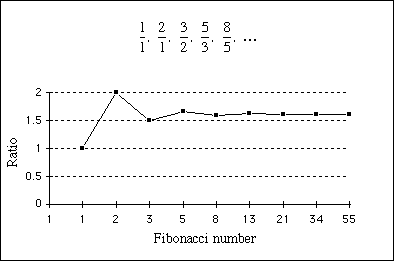
If you plot a graph of these values you’ll see that they seem to be tending to a limit. This limit is actually the positive root of a quadratic equation (see box) and is called the golden section, golden ratio or sometimes the golden mean.
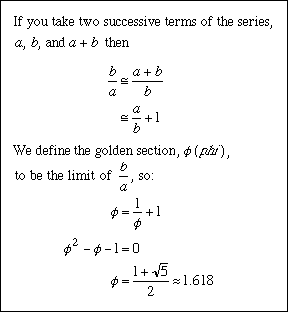
The golden section is normally denoted by the Greek letter phi. In fact, the Greek mathematicians of Plato’s time (400BC) recognized it as a significant value and Greek architects used the ratio 1:phi as an integral part of their designs, the most famous of which is the Parthenon in Athens.
The Parthenon in Athens.
Phi and geometry
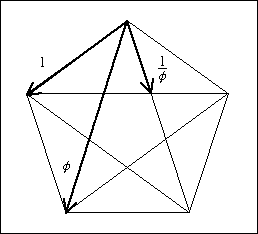
Phi also occurs surprisingly often in geometry. For example, it is the ratio of the side of a regular pentagon to its diagonal. If we draw in all the diagonals then they each cut each other with the golden ratio too (see picture). The resulting pentagram describes a star which forms part of many of the flags of the world.
Fibonacci in nature
The rabbit breeding problem that caused Fibonacci to write about the sequence in Liber abaci may be unrealistic but the Fibonacci numbers really do appear in nature. For example, some plants branch in such a way that they always have a Fibonacci number of growing points. Flowers often have a Fibonacci number of petals, daisies can have 34, 55 or even as many as 89 petals!
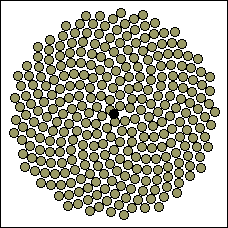
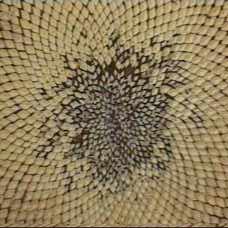
Finally, next time you look at a sunflower, take the trouble to look at the arrangement of the seeds. They appear to be spiralling outwards both to the left and the right. There are a Fibonacci number of spirals! It seems that this arrangement keeps the seeds uniformly packed no matter how large the seed head.
Fibonacci in Maths
The Fibonacci numbers are studied as part of number theory and have applications in the counting of mathematical objects such as sets, permutations and sequences and to computer science.


No comments:
Post a Comment