Pages

Thursday, July 28, 2011

MA ALERT INDICATOR

MA ALERT

Free download Indicator MA ALERT mq4 for Metatrader 4 and Metatrader 5. Please rate and review MA ALERT mq4 Indicator. It is easy to install these Indicator to your Metatrader. You don’t have to pay anything for this indicator – it is completly free. The MA ALERT mq4 Indicator is made for all Metatrader Clients – you can easly attach it to your chart.

Download MA ALERT mq4 (right Click – save as…)

How to install MA ALERT mq4?

  • Download MA ALERT mq4
  • Copy MA ALERT mq4 to your Metatrader Directory / experts / indicators /
  • Start or restart your Metatrader Client
  • Select Chart and Timeframe where you want to test your indicator
  • Search "Custom Indicators" in your Navigator mostly left in your Metatrader Client
  • Right click on MA_ALERT.mq4
  • Attach to a chart
  • Modify settings or press ok
  • Indicator MA ALERT mq4 is available on your Chart

How to remove MA ALERT mq4 from your Metatrader Chart?

  • Select the Chart where is the Indicator running in your Metatrader Client
  • Right click into the Chart
  • "Indicators list"
  • Select the Indicator and delete

Thursday, July 21, 2011

AVG ANTI-VIRUS FREE EDITION-FREE DOWNLOAD

AVG Anti-Virus Free Edition - trusted by 80 million users

Antivirus and antispyware protection for Windows available to download for free

NEW! LinkScanner® Active Surf-Shield checks web pages for threats at the only time that matters – when you’re about to click that link.

AVG Anti-Virus Free Edition
  • Award-winning antivirus and antispyware
  • Real-time safe internet surfing and searching
  • Quality proven by 80 million of users
  • Easy to download, install and use
  • Protection against viruses and spyware
  • Compatible with Windows 7, Windows Vista and Windows XP

AVG Anti-Virus Free Edition is only available for single computer use for home and non commercial use.


FREE DOWNLOAD NOW


OR PLEASE VISIT http://free.avg.com/download-avg-anti-virus-free-edition

TAMIL-ENGLISH/ENGLISH-TAMIL DICTIONARY


TAMIL-ENGLISH/ENGLISH-TAMIL DICTIONARY FREE DOWNLOAD
PLEASE CLICK ABOVE "INSTALL"BUTTON

WORLDWEB-ENGLISH DICTIONARY FREE DOWNLOAD


This thesaurus/dictionary can be used to look up words from almost any program. In addition to displaying sense definitions and synonyms, WordWeb can find sets of related words. The database has more than 150,000 root words and 120,000 synonym sets, many proper nouns, pronunciations, and usage tags. WordWeb works off line, but when online you can also quickly view Web references such as the Wikipedia encyclopedia.

WordWeb is a handy utility that gives you the definition, synonyms, and antonyms of any given word without requiring you to go online, though it can connect to the Internet for expanded functionality should you want it.

The interface feels like an expanded version of any major word processing app's dictionary function, giving users an instant familiarity--even if they've never used WordWeb. After you type a term into the Lookup dialog box, the word's definition will appear in the interface's top pane, along with tabs that link to various wiki functions.

The bottom pane offers tabs for such items as synonyms, antonyms, and related words. The app's most notable feature is its hot key support; you simply use a hot key combo when the cursor is pointed over any word, and WordWeb will pop up onscreen with all pertinent information.

There are tools for changing the database to one of several English variations, altering the text size, and disabling WordWeb from recognizing offensive terms. The depth and functionality of WordWeb would be worth paying for, but thankfully you don't have to redefine your budget to get it--it's free.


Free Download Now

TAMIL-ENLISH TYPING TUTOR

TAMIL-ENLISH TYPING TUTOR


Aasaan - Tamil/English Typing Tutor software is a very simple guide to learn touch typing. Today, large number of software engineers and technical staff are using only their two fingers while typing. This is because of not learning the touch typing through a proper course. By using this software, you can learn the basics very quickly, that is within 6 to 10 hours.

Also your time will not be wasted. Depending upon your speed, you can learn other lessons too. Thus you can master in the touch typing. The specialty of this software is that typing exercises are provided for three different types of keyboard in a single software. You will also find that the lessons are being taught in dual language (English and Tamil). Version 1 includes unspecified updates.

(OR)

Wednesday, July 20, 2011

Free Nifty Futures Realtime Charts in MetaTrader Platform

There are variety of useful and Intelligent products available in the market at free of cost. One such product is
GCI Trading’s MT4 metatrader 4 platform for Nifty Futures Realtime charts. MT4 Platform is a highly sophisticated
automated trading platform. Other than Nifty you can also get Forex, World Indices, US Stocks and Dollar Denominated Commodities live charts at free of cost.

1)Download and Intall the GCT Trading Software
2)When launching the program for the first time, you will see a window with the registration form; after you have filled it in, you will automatically get a demo account.
3)Now Right Click on the Market Watch
4)Select SYMBOLS
5)To get Nifty Futures goto Indexes and select NSE_Nifty among the list
6)Click on the Tab SHOW
7)Now the Corresponding Ticker will be available in the Market Watch
8)To get the chart just right click on the Ticker and Select Chart Window
10)Now Charts are live and you can change the Peridicity of the chart and change it for the required time frame(1 Min, 5Min, 15Min,Hourly,Daily,Weekly,Monthly
11)Setup Ichimoku Indicator for Metaquotes

Sample Chart for Nifty 15 min Chart has been shown

Wednesday, July 13, 2011

CANDLE PATTERNS

Many people believe that high profit candlestick patterns are found by simply identifying the bars in the candle chart alone. However the truth is that while Japanese candlestick charting patterns are an excellent tool to use in your technical analysis, determining if they are high probability or not is dependent upon where they occur in the context of the chart.

Finding a doji, shooting star, dark cloud cover or hanging man candlestick is not enough for a high probability and high profit trading signal whether you are trading the stock market, futures for the Forex market.

This brief video demonstrates the concept that high profit candlestick patterns, by themselves, do not consistently produce reliable, profitable trading signals.

This is a very basic video for those fairly new to candle charts. If you’re looking for more advanced candlestick teaching I’ll be offering that in the future.

    ORGIN OF CANDLESTICKS-1

    In the early 1700s, a wealthy Japanese rice merchant, Munehisa Homma, developed a system of tracking and analyzing rice futures, which over time matured into the high profit candlestick patterns we know today. Homma is credited for creating or developing these specialized Japanese candlestick trading signals during the early history of the futures market.

    Until about 1710, actual rice was traded from hand to hand. The futures market was developed with the idea that traders gave coupons or a promise to deliver rice at some future date. This quickly emerged as a very lucrative form of business so the futures market was born.

    Homma’s business sense and ability to read the candle chart was unparalleled in his time. His ability to analyze the rice futures using what is now called Japanese candlestick charting techniques revolutionized trading and as such made him possibly the wealthiest trader in market history.

    Terms like Dark Cloud Cover, Doji Candlestick, Shooting Star, and Hanging Man Candlestick are bantered about in trading circles probably with little thought for their humble beginnings in the rice trade and the infant futures market. What we are left with is a powerful collection of trading signals when we learn how to read candlestick charts for trading the futures, stock or Forex market.

    The techniques that Homma began using 300 years ago can still be effectively used in today’s online trading environment as part of a complete technical analysis trading plan.

    Here are some basic terms and concepts of the candlestick patterns:

    A candle represents the high, low, open and close of a commodity, stock or currency for a certain period of time. Stocks, commodities and currencies can be traded in almost endless time frames such as 1, 5, 15 minute, 1 hour, 1 day, and 1 week time periods. For example on a one minute chart, one candle equates to how much the price moves on the market in one minute.

    A bull candle, which is indicating increasing price, shows the opening price at the bottom of the body of the candle and the close price at the top of the body. Any extensions (called shadows or the wick of the candle) show the high and low price for that period.

    A bear candle shows the opposite of the bull or a decreasing price: the top of the body of the candle indicates the opening price for that period and the bottom of the body of the candle indicates the close, with the shadow indicating the high and low price for that period.

    The Bullish Japanese candlestick pattern is usually color coded green

    The bullish Japanese candlestick pattern is usually color-coded green (close above the open)

    The bearish japanese candlestick pattern is usually color-coded red (close below open).

    The bearish Japanese candlestick pattern is usually color-coded red (close below open).

    orgin of candlesticks


    Much study has been devoted to Japanese candlestick charting techniques. Steve Nison originally made detailed analysis of these trading signals and traders ever since have benefited from some form of his work.

    In trading software, a chart moves or updates according to the chosen time period and as the candle pattern reflects the ups and downs of the market, in time a trader can learn how to read candlestick charts.

    The market is driven by many things, most notably national and international news and economic forecasts. Traders react in certain ways and the chart patterns show up in the candle chart. As candles appear in relation to one another, they form patterns that show trends and thus help traders make decisions of when to enter and when to exit a trade.

    In this way, traders get a feel for the market and can make educated determinations as to when to buy or sell. Buying and selling stocks, futures and the Forex market is a difficult business but experienced traders have managed to reduce a certain amount of the risk by using the Japanese candlestick charting techniquesdevised by Homma and brought to the West by Steve Nison.

    Here are a few examples of well-known candlestick patterns:

    A Hammer candlestick may appear as the market is moving down, indicating a change trend and a possible bottom being put in place. It has a short body with a long wick below the real body indicating a possible rejection of the prices below it. If there are other indications confirming the candlestick pattern, a trader may then decide to enter a long position in the Forex market or buy stock, futures or options.

    On the other hand, the Hanging Man (which is the same single candlestick pattern, but occurs while a market is moving up) indicates the opposite – that the trend may change and start going down or bearish.

    A Doji is a candle that has no body – the open and close were the same. One may still consider it bullish or bearish depending on the length of the wick (or “shadow”) and whether there is a longer wick above or below the real body, as well as where it occurs in the overall chart pattern.

    Another popular candle pattern is the Spinning Top. Here the candle body is small and the wicks on both ends are longer than the body. This pattern indicates uncertainty in the market so the trader will likely wait.

    These are only a few of multitudes of candlestick types which play a part in how traders use Japanese candlestick charting patterns to help them make their trading decisions.

    Candlestick techniques are just one aspect of technical analysis and so should not be used exclusively to make trading decisions. One must also consider support and resistance, the larger trend, cycles, momentum and other time frames.

    Intraday

    "POSITIONAL SELL DCB BELOW 60
    TGT 54-53 / 49-47 CARRY SL 63 CLOSING
    EXIT INTRADAY IF CLOSE ABOVE 60
    CASH LEVELS
    USE INTRADAY RISE TO SHORT NIFTY - SL 5580 CLOSING NIFTY SPOT

    OUT OF 14 COUNTER 7 COUNTERS ACTIVE ON BREAK BELOW RATE ALL CASH LEVELS
    AXISBANK-1300, BHUSGNSTL-438, HDFC-710, IDFC-132.30, INFY-2960 , JSWSTEEL-875, POWERGRID-108, TATASTEEL-590
    IF CLOSING ABOVE THE ABOVE RATES THEN EXIT - ELSE HOLD FOR TGT

    FOLLOWING COUNTERS WILL GET ACTIVE ON BREAK BELOW
    IFCI - 46.40, TATAPOWER - 1270, RELCAP- 578, RCOM - 96.40, KOTAKBANK - 470


    POSITIONAL SHORT 14 COUNTERS - ALL CASH LEVELS
    TATASTEEL, TATAPOWER, SIEMENS, RELCAP, RCOM POWERGRID
    KOTAKBANK, JSWSTEEL, INFY, IFCI, IDFC, HDFC, BHUSANSTL, AXISBANK
    SELL BELOW ???? SL ???? TGT ???? MORE ????"

    Friday, July 1, 2011

    Quick Summary


    Trading with Stochastic indicator involves the following signals:

    Stochastic lines cross — indicates trend change.
    Stochastic readings above 80 level — currency pair is overbought,
    Stochastic staying above 80 level — uptrend is running strong.
    Stochastic exiting 80 level downwards — expect a correction down or beginning of a downtrend.
    Same for readings below 20 level — currency pair is oversold,
    staying below 20 — doentrend is running strong,
    exiting upwards above 20 — expect an upward correction or a beginning of an uptrend.

    Details


    The idea behind Stochastic indicator

    The main idea behind Stochastic indicator according to its developer, George Lane, lies in the fact that rising price tends to close near its previous highs, and falling price tends to close near its previous lows.

    How to interpret Stochastic indicator


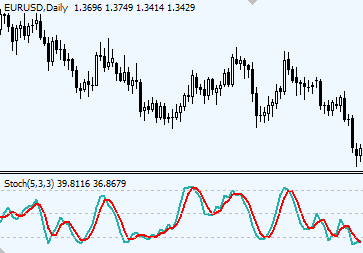
    Stochastic is a momentum oscillator, which consists of two lines: %K - fast line, and %D - slow line. Stochastic is plotted on the scale between 1 and 100.
    There are also so called "trigger levels" that are added to the Stochastic chart at 20 and 80 levels. Those lines suggest when the market is oversold or overbought once Stochastic lines pass over them.

    How to trade with Stochastic indicator


    Let’s look at three methods of trading with Stochastic indicator.

    Method 1. Trading Stochastic lines crossover

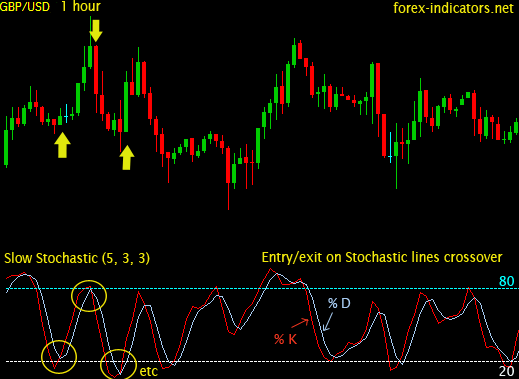
    This is the simplest and common method of reading signals from Stochastic lines as they cross each other. Stochastic %K and %D line work similar to moving averages and:
    when %K line from above crosses %D line downwards traders open Sell orders.
    when %K line from below crosses %D line upwards traders open Buy orders.

    Stochastic lines crossovers that happen above 80% level and below 20% level are treated as strongest signals, compare to crossovers outside those levels.

    Traders may choose sensitivity of their Stochastics. The smaller the Stochastic parameters, the faster it will react to market changes, the more crossovers will be shown.

    Sensitive Stochastic (for example 5, 3, 3) is useful for observing rapidly changing market trends. But because it is too choppy it should be traded in combination with other indicators to filter out Stochastic signals.Stochastic lines crossoverStochastic Indicator ForexStochastic lines crossoverMethod 2. Trading Stochastic oversold/overbought zones

    Stochastic by default has 80% level, above which market is treated as overbought, and 20% level, below which market is considered oversold.

    It is important to remember that while in sideways moving market a single Stochastic lines crossover that occur above 80% or below 20% will most of the time result in a fast predictable trend change, in trending market could mean just nothing. When price is trending well, Stochastic lines may easily remain in overbought/oversold zone for a long period of time while crossing there multiple times.

    That’s why a method of trading overbought/oversold zones stands up. The rules here are to wait until Stochastic lines after being in overbought/oversold zone come out from it. E.g. When stochastic was trading for some time in overbought zone – above 80% level, traders wait for the lines to slide down and eventually cross 80% level downwards before considering to take Short positions. Opposite for Long positions: wait till Stochastic lines come into the oversold zone (below 20% level); wait further until Stochastic lines eventually cross 20% level upwards; initiate a buy order once Stochastic lines are firmly set, e.g. a trading bar is closed and Stochastic lines cross over 20% mark is fixed.Method 3. Trading Stochastic divergence

    Traders are looking for a divergence between Stochastic and the price itself. At times when the price is making new lows while Stochastic produces higher lows creates dissonance in the picture. It is called divergence. Divergence between price and Stochastic readings suggest a forming weakness of a main trend and therefore its possible correction.

    Full versus Fast versus Slow stochastic


    Full Stochastic inidcator has 3 parameters, like: Full Stoch (14, 3, 3), where the first and the last parameters are identical to those found in Fast and Slow Stochastic:
    the first parameter is used to calculate %K line, while the last parameter represents the number of periods to define %D - signaling line.
    The difference between Full and other Stochastics lies in the second parameter, which is made to add smoothing qualities for %K line. Applying this smoothing factor allows Full Stochastic be a bit more flexible for chart analysis.